
Z-classification: an anatomy-based ridge–sinus–zygoma classification and decision funnel for zygomatic implantology
Zarrine S, Ilic I, Ilic B, Lazic M, Markovic A · Clin Oral Invest 30, 433 (2026) · Open access
Read the reference article ↗Understanding the Z-Classification
This website is dedicated to the practical application of the Z-Classification, an anatomy-based decision framework developed to support preoperative planning in zygomatic implant rehabilitation.
Through a step-by-step interactive decision funnel, clinicians are guided through the assessment of the key anatomical and prosthetic parameters described in the Z-Classification, including residual ridge morphology, subantral bone height, lateral sinus wall anatomy, and prosthetic alignment. Based on these observations, the tool identifies the corresponding Z-grade and illustrates the surgical strategy associated with that anatomical situation, including the planned implant trajectory, the need for a visualisation opening, and the indication for crestal placement or cervical bone housing.
The final result is presented through an interactive 3D anatomical model of the situation and can be generated as a printable PDF summary, providing a clear visual record of the planning process.
This tool is intended as an educational and clinical decision-support resource for trained clinicians. It does not replace CBCT-based diagnosis, prosthetically driven planning, or the surgeon's clinical judgement.
Classification
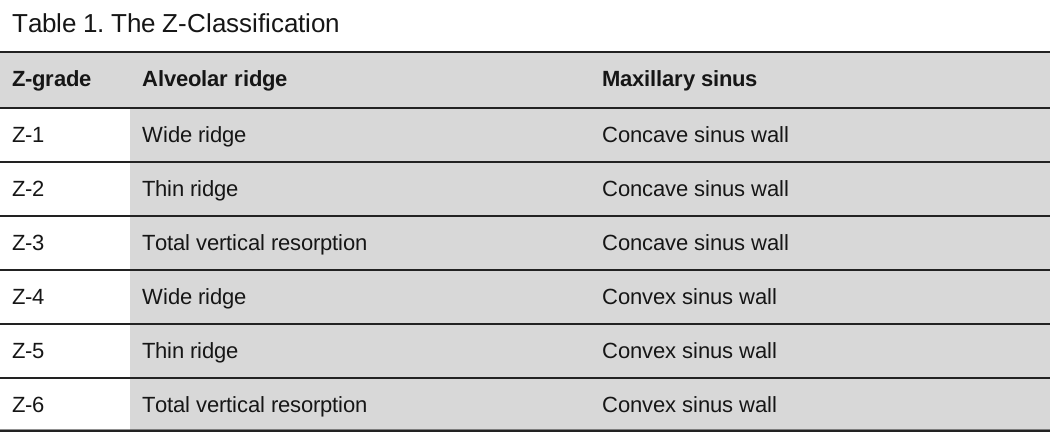
| Z-grade | Alveolar ridge | Maxillary sinus |
|---|---|---|
| Z-1 | Wide ridge | Concave sinus wall |
| Z-2 | Thin ridge | Concave sinus wall |
| Z-3 | Total vertical resorption | Concave sinus wall |
| Z-4 | Wide ridge | Convex sinus wall |
| Z-5 | Thin ridge | Convex sinus wall |
| Z-6 | Total vertical resorption | Convex sinus wall |
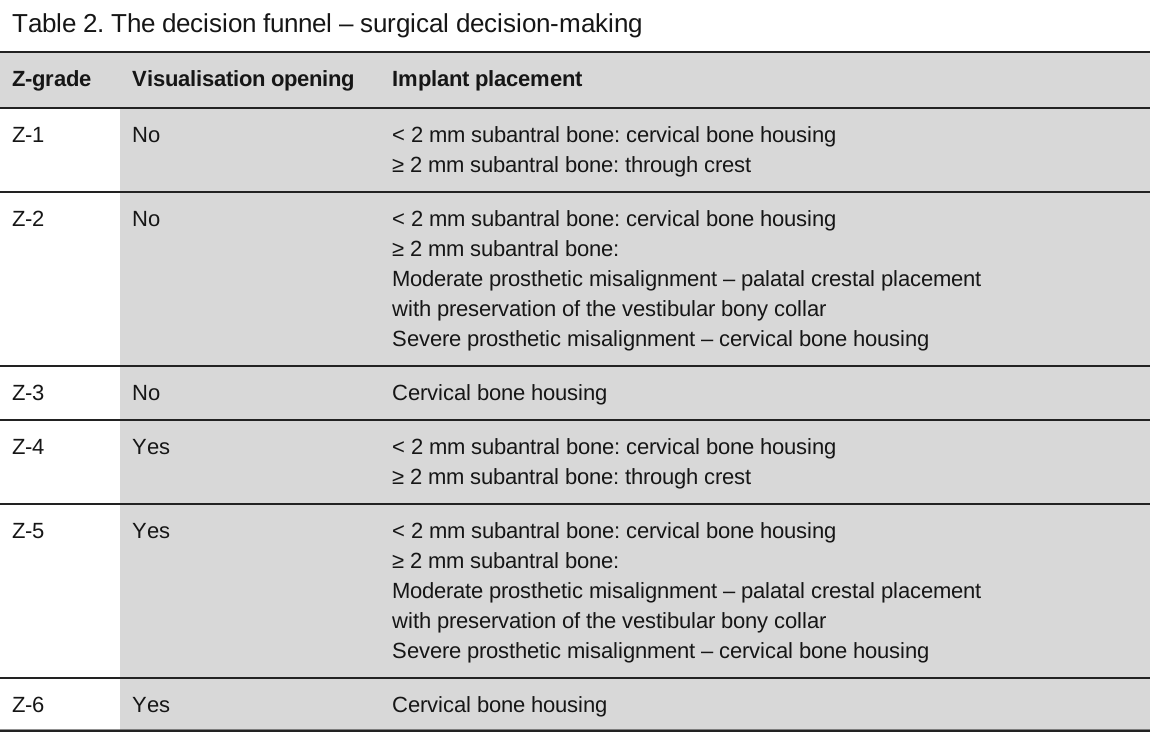
| Z-grade | Visualisation opening | Implant placement |
|---|---|---|
| Z-1 | No | < 2 mm subantral bone: cervical bone housing ≥ 2 mm subantral bone: through crest |
| Z-2 | No | < 2 mm subantral bone: cervical bone housing ≥ 2 mm subantral bone: Moderate prosthetic misalignment – palatal crestal placement with preservation of the vestibular bony collar Severe prosthetic misalignment – cervical bone housing |
| Z-3 | No | Cervical bone housing |
| Z-4 | Yes | < 2 mm subantral bone: cervical bone housing ≥ 2 mm subantral bone: through crest |
| Z-5 | Yes | < 2 mm subantral bone: cervical bone housing ≥ 2 mm subantral bone: Moderate prosthetic misalignment – palatal crestal placement with preservation of the vestibular bony collar Severe prosthetic misalignment – cervical bone housing |
| Z-6 | Yes | Cervical bone housing |
Tables 1 and 2 are reproduced from: Zarrine S, Ilic I, Ilic B, Lazic M, Markovic A. Z-classification: an anatomy-based ridge–sinus–zygoma classification and decision funnel for zygomatic implantology. Clin Oral Invest 30, 433 (2026). DOI: 10.1007/s00784-026-07124-y. The article is open access, free to read, and published under the CC BY-NC-ND 4.0 licence.
Article
Zarrine S, Ilic I, Ilic B, Lazic M, Markovic A · Clin Oral Invest 30, 433 (2026) · Open access
Read the reference article ↗Put the framework into practice